Most roof problems don’t announce themselves. They start small—a lifted shingle, a faint water ring on the ceiling—and stay quiet until a storm turns a minor issue into an emergency. Knowing what to look for, and when to act on it, is the difference between a simple fix and a much bigger repair bill down the road.
Signs Your Roof Needs Repair
Catching signs your roof needs repair in Rhode Island early is the single best thing a homeowner can do to protect the rest of the house. Walk your property a few times a year and look for:
- Ceiling stains or discoloration—even a faint yellow-brown ring means water has already gotten past the roofing surface
- Curling, cracked, or missing shingles—sun and salt air break down shingle edges faster along the coast
- Granules in the gutters—asphalt shingles shed granules as they age; a buildup at the downspout is an early aging signal
- Sagging rooflines—any dip or unevenness along the roof deck suggests structural moisture damage underneath
- Daylight in the attic—gaps around vents, chimneys, or the roof deck itself let in water long before they let in visible light
- A musty attic smell—trapped moisture often shows up as odor before it shows up as a stain
None of these need to turn into a crisis. Caught early, most of them are a straightforward, contained repair.
Roof Leak Repair Rhode Island Homes Need Most Often
Roof leak repair Rhode Island homeowners request most often traces back to a handful of recurring weak points, not the shingles themselves:
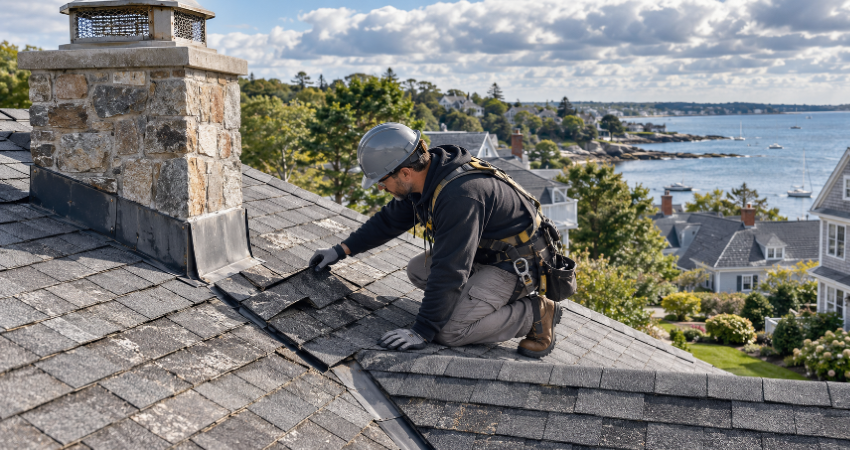
- Flashing around chimneys, vents, and skylights— these transitions are where roofs most commonly fail first
- Valleys, where two roof slopes meet and water volume concentrates
- Ice dams along the eaves in winter, which force meltwater back under the shingles
- Pipe boots, the rubber collars around plumbing vents, which crack and shrink with age faster than the surrounding roof
Water rarely enters and drips straight down. It travels along the underside of the decking and rafters before showing up on a ceiling, often several feet from where it actually got in. That’s why a DIY patch over the visible stain frequently misses the real source, and why a proper leak repair starts with tracing the water back to its entry point, not just covering the symptom.
The Best Time to Repair a Roof in New England
There’s a real answer to the best time to repair a roof, and it’s not “whenever it breaks.” Spring and fall are the ideal windows for Rhode Island roofs:
- Spring repairs address whatever the winter’s freeze-thaw cycles and nor’easters loosened, before summer thunderstorms test those same weak points again
- Fall repairs shore up the roof before ice and heavy wind season, when access gets harder and emergency repairs cost more
- Mid-summer is workable but roofing crews are at their busiest, so scheduling can stretch out
- Deep winter repairs are sometimes unavoidable for active leaks, but cold-weather sealants and shingle adhesion don’t perform as well as they do in milder conditions
If your roof shows early warning signs and there’s no active emergency, scheduling the repair for spring or fall — rather than waiting for the next storm to force the issue — usually means a cleaner, longer-lasting fix.
Choosing a Local Roof Repair Contractor
Not every roofer understands what coastal New England does to a roof. When vetting a local roof repair contractor, a few things matter more than a low quote:
- Familiarity with coastal conditions—salt air, wind-driven rain, and freeze-thaw cycles behave differently than they do inland, and a contractor who works the shoreline regularly will spot problems a generalist might miss
- A real inspection before a recommendation—a contractor who quotes a repair without getting on the roof (or at least reviewing clear photos) is guessing
- Plain-language explanations—you should understand what’s wrong and why the recommended fix addresses it, not just see a line-item invoice
- Local reviews and local addresses—a contractor with a track record in your specific towns is easier to hold accountable than one working from out of state
A good local contractor treats a small flashing repair with the same care as a full roof job, because a rushed small repair is often how a bigger one gets created.
Don’t Wait for the Next Storm
If you’ve noticed any of the warning signs above, the smartest move is an inspection now, not after the next nor’easter. Markopoulos Roofing serves homeowners across Providence, Warwick, Cranston, Pawtucket, East Providence, Newport, Bristol, and the greater Narragansett Bay area, with crews who know exactly what coastal exposure does to a roof over time.