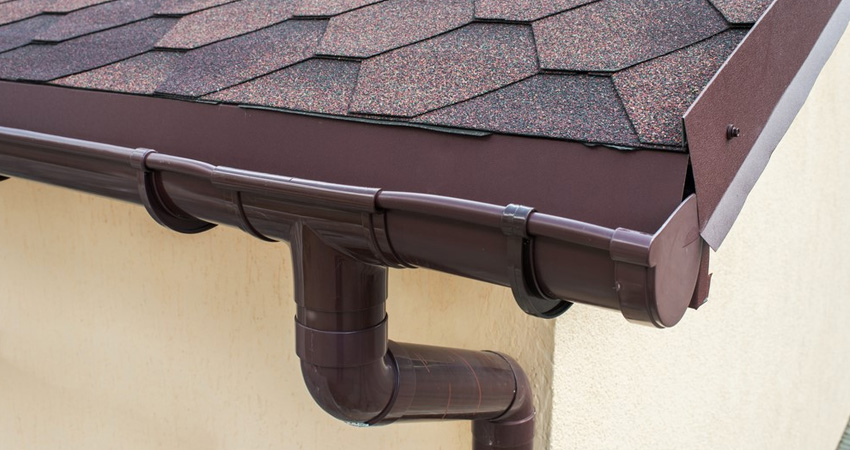
Gutters are the least glamorous part of a house and one of the easiest to ignore until something goes wrong. Their job is simple: move water off the roof and away from the building. When they stop doing that, the damage does not stay at the gutter line — it shows up in the fascia, the soffit, the siding, and eventually the foundation.
Markopoulos Roofing has been installing gutter systems since 2018. We handle new seamless gutter installation, repairs to existing systems, downspout work, and cleaning, for homes and commercial buildings in Worcester and the surrounding towns. Installation is typically completed in a single day, with over 100 colours available to match your trim.
A gutter system in Worcester works harder than one in a milder climate, and fails faster when it is undersized or neglected.
Snow and ice weight. A gutter full of frozen water and packed snow carries serious weight. That load pulls on the hangers and, over a few winters, drags the gutter away from the fascia. Once it is pitched wrong, water pools in it, which makes the next freeze worse.
The ice dam connection. Clogged gutters do not cause ice dams — attic heat loss does. But a gutter packed with wet leaves gives meltwater nowhere to go, so it sits at the eave and freezes solid. That ice then becomes part of the dam. If you get ice at your eaves every winter, the gutters are worth clearing, but the attic insulation and ventilation are what actually need attention.
Heavy rain volume. Central Massachusetts gets substantial rainfall on top of the snow. An undersized gutter or a single downspout serving too much roof area will overflow in a hard rain regardless of how clean it is.
Freeze-thaw on seams. Water trapped in a sectional gutter joint expands when it freezes. Every cycle opens the seam a little further. This is the single most common failure point on older gutter systems here.
Sectional gutters come in standard lengths and are joined together on site. Every joint is a potential leak, and in this climate they do eventually leak. Seamless gutters are formed on site from a continuous coil to the exact length of your roof run, so the only joints are at corners and outlets.
The practical differences: fewer seams means fewer leak points and fewer places for debris to catch, which means fewer blockages. Seamless runs also look cleaner, with no visible joint lines along the fascia. Sectional systems cost less up front, but in a freeze-thaw climate the seams are what you end up paying for later.
Standard residential gutter is 5-inch K-style. For many Worcester homes that is fine. But if you have a large roof area draining into one run, a steep pitch that throws water fast, or valleys that concentrate flow into one spot, 5-inch will overflow in heavy rain no matter how well it is installed.
In those cases 6-inch gutter with larger downspouts is the right answer. It holds roughly 40% more water and clogs less readily because the outlet opening is bigger. We look at roof area, pitch and valley layout when quoting rather than defaulting to whatever is standard.
Downspout placement matters as much as gutter size. Too few downspouts, or downspouts that discharge right at the foundation, move the problem rather than solving it.
Not every gutter problem needs a full replacement. Common repairs include re-pitching runs that have sagged so water drains instead of pooling, replacing failed hangers, resealing corners and end caps, reattaching or re-routing downspouts, and repairing the fascia board behind a gutter that has been leaking.
That last one is worth checking. If water has been running behind the gutter rather than through it, the fascia and sometimes the roof decking edge underneath will be soft. Putting a new gutter on rotten fascia means doing the job twice.
Guards reduce how often you need to clean gutters. They do not eliminate it. Fine debris, shingle grit and seed pods still get through most systems, and guards themselves need occasional clearing. Under heavy tree cover they are usually worth it. On a house with no overhanging trees, they often are not.
We will tell you honestly whether your property is a case where they pay for themselves.
In this part of Massachusetts, twice a year is the realistic schedule: once in late spring after the seed pods and blossoms drop, and once in late autumn after the leaves are down. The autumn clearing matters most — going into winter with blocked gutters is what sets up the ice problems described above.
If your property has mature oaks or maples close to the house, you may need a third pass mid-autumn.
Water spilling over the edge during rain. Gutters visibly sagging or pulling away from the fascia. Staining or streaking on the siding below the gutter line. Peeling paint or rot on the fascia board. Pooling water or erosion in the soil at the base of the house. Visible plant growth in the gutter — if something is growing in it, it has been holding soil and water for a while.
Aluminium seamless gutters typically last a long time when properly pitched and maintained. What usually fails first is not the gutter material but the hangers, the sealant at corners, and the fascia behind it.
It depends on roof area, pitch and how many valleys drain into the run. If your current gutters overflow in heavy rain even when clean, that is a sizing problem, not a cleaning problem.
No. Ice dams come from heat escaping into the attic and melting snow on the roof. Clean, correctly sized gutters help the meltwater get away, but the fix for ice dams is insulation and ventilation.
Yes, residential and commercial both.